Translate

Showing posts with label Strictly Horticultural. Show all posts

Sunday, February 21, 2016

Vera, You Are Utterly Fabulous: Leycesteria formosa

Being the completely appalling wretch that I am, (and Darling of my charming, witty and erudite readers), I haven't been checking my emails for months. Consequently I missed Vera's ident which she hopefully posted alongside this post about Rod Stewart
 
Anonymous (that's Vera) said...
 
I wanted to comment your Sheffield Botanical Gardens; What Is This Plant? (posted on Thursday, January 09, 2014, but it has not comments allowed). In case no one answered it yet. :) I guess it's Leycesteria formosa. :)
Vera

Yes. Yes, absolutely correct. Thank God for people like Vera.


Thursday, January 09, 2014

Sheffield Botanical Gardens; What Is This Plant?

 
Another trip over to the Sheffield Botanical Gardens this afternoon, after an arduous hour in John Lewis replacing half a dozen assorted pieces of Robert Welch cutlery that appear to have gone walkabout since the start of the year. It wasn't arduous at all. Quite the opposite, actually. John Lewis was pretty much deserted, so much so that I wandered up the escalators and bought some lovely little White Stuff woollies and an Alice Temperley dress. But back to the Botanical Gardens, beautifully stripped back by winter and experienced staff supported by tremendously knowledgeable volunteer gardeners...


Now, my charming, witty and erudite readers, I have a little task for you all. Hop in the car and belt up the M1 to Sheffield then career off at J31 along the A57; jump left onto the A61 and stay on it until you get to the big roundabout St Mary's Gate / Waitrose; take the first left onto the A625 Ecclesall Road, and stay on it until you come to the roundabout where you need to go right up the hill onto the B6069 Brocco Bank.  Follow the road up past the student uni flats on the left hand side and swing right as the road becomes Clarkehouse Road.  Near the pedestrian crossing you'll see free parking on both sides of the road.  Park up and stroll across to the Botanical Gardens. Free admission.

 
Walk downhill towards the fountain. Standing with your back to the fountain, sparkling droplets in the bright winter sunshine, walk up towards the glasshouses between the two large herbaceous borders.  About halfway up on the right hand side you'll see a gap in the hedge backing the border, where the following plant grows.  It's about 5' or 6' tall, woody and still with some crimson coloured racemes.  Those racemes would put you in mind of a Corylopsis Pauciflora.


At the end of last year I decided that I really ought to get my photos sorted out into some sort of meaningful order, rather than the strip-dumps of, "2013 summer?" "Sheffield 2013?" Some don't even have that measure of effort. Anyway, suffice to say I've dated, filed and shifted hundreds of photos from last year, and now I can't find a thing. Somewhere I have a picture of the fountain at the Sheffield Botanical Gardens; the one above's in Dublin.

Incidentally, the pictures above of the as-yet-unknown plant (which is just a thinly veiled plea to Helen Yemm to name it), which you'll see EVERYWHERE in Sheffield, were taken sometime in the Autumn.

Sunday, March 24, 2013

Rose Balling: Rosa Eglantyne


What causes rose balling?  Rose balling is an annoyance that dominates in a damp, cool summer exactly like the one we endured in sunny Derbyshire in 2012.  Flower buds develop normally but fail to open fully.  Wet weather saturates the outer petals and when the sun finally puts in an appearance and scorches the flower dry, the outer petals are fused together preventing full opening.  These fused petals dry to a crisp, brown appearance.   
Rose balling can be a problem if you've planted roses in a partially shaded site, and you've got a penchant (as I) for roses with a multitude of thin petals.  Rosa Eglantyne and Geoff Hamilton are particularly vulnerable in my garden, whilst my peonies and camellias appear to be thus far unaffected.  Clearly the site is the predominant problem. 
 
Standard advice seems to be pruning to open up a lovely goblet shaped bush thus enabling good air circulation and rapid drying of the flower buds after rainfall; watering in the evenings only (laughable advice last summer); removing balled buds promptly before grey mould sets in and infects both host and nearby plants with a whole new set of problems; and rather drastically, removing or cutting back overhanging shrubs and trees.
 
Reading this advice last year on the RHS website finally prompted me to tackle my knackered old Warwickshire Drooper plum tree, stalwart of hundreds of jars of my world famous spiced plum chutney (thank you Delia.)  More of that in a forthcoming post.

Saturday, March 23, 2013

On Stalking Helen Yemm

I know, I can't believe I've written that post title, either... 
 All photos Daily Telegraph
Something else I can't believe is that Helen Yemm IS FINALLY BLOGGING AGAIN.  Well, not really blogging, just turning in her annual copy... Click on this ----> OMG!to read her latest article about her most recent book, Gardening in Pyjamas. This book will appeal to those gardeners, myself and all my charming, witty and erudite readers ofc, who like Helen, are, 
"Keen enough, daft enough, to get out there in all weather first thing in the morning (usually inappropriately dressed, hence the title) but didn’t quite know what to get on with and how to go about it – and why."  Buy it here...
 
Although I have to tell you, Helen, I know exactly what to get on with, armed with my secateurs and assorted WMD... indiscriminate pruning! 
 

Here's a lovely shot above of Helen pruning an offensive cat out of its lair.

Here's a lovely shot of Helen crushing the evidence.

Here's a lovey shot of Helen about to spread the crushed evidence around the roses and top fruit.

 And this is just a random shot of Helen being fabulous. 
 
You know, it strikes me that if Chief Warrant Officer Roy Miller had had a certain someone in his squad, he'd have found those WMD...


Tuesday, December 04, 2012

Cerinthe Major Purpurescens at Blakesley Hall


I have coveted these beauties since I saw a stall holder at Bakewell farmers' market including them in her hand-tied garden flower bouquets.  Oh wow, I thought, why haven't I thought to grow these flowers.  Growing them couldn't be simpler, you just throw the seeds into the soil sometime round about mid to late spring, cover lightly then wait until they flower in earlyish summer.  And, as these little fellows are prolific self-seeders, you'll have plenty in your borders next year.  They'll need a bit of protection over a hard winter, given that they are Mediterranean evergreens, but these glaucous leafed delights are worth even this little bit of effort, especially if you treat them as a hardy annual.
The Cerinthe here were covered in bees, even in October, so you'll be giving your local bee colony an autumn treat if you get a bush or two into your garden.
 
The only difficulty I've had with Cerinthe is getting hold of the seeds in the first place.  You'll have to shop online (no great hardship), but if we are as a nation and a global community supposed to be taking action to reverse the global decline in bee colonies, it might help to shift these seeds into the budget range at B&Q.
 
 
And don't forget, December's farmers' market is held a week early for Christmas, on Saturday 22 December.  See you there.

Friday, November 09, 2012

On Planting Lettuces / Why Do Lettuces Bolt?

"In March I sowed strips of Cos lettuces together with a packet of mixed lettuces I like to describe as frilly knicker lettuces.  You get the idea.  They really ought to have been planted out a couple of weeks ago, but my obscenely busy schedule made this impossible.  Each morning I'd stare out at the kitchen garden, cup of tea in hand and say to myself "I really must get those lettuces in..."

Matters reached crisis..."


And there I left it, having reached across my desk to answer the phone and then become embroiled in busyness.  And now, some five months on from this draft I'm composing a post about bolting lettuces.  Bolting refers to the sudden onset of your lettuces stretching up from their main stem, as if to catch up with the Borlottis you planted nearby, rather than remaining a nicely bunched, tightly curled head of leaves a few inches from the ground.  Bolting can be triggered by either a few days of cold weather, stress or by changes in the day length as the growing season progresses. 


Lettuces are particularly sensitive to the amount of daylight received, and given the appalling spring, summer and autumn we've had here in sunny Derbyshire, I'm overly delighted to have grown any usable lettuce at all.  There really isn't much you can do, except to pick your leaves as you need them, and enjoy the beauty of your bolting salad greenery.


Monday, June 04, 2012

Robert Marnock Garden Sheffield

Oh beautiful hellebores, my heart belongs to you.


Friday, April 13, 2012

Orlaya Grandiflora: White Lace Flower

I finished early today, and once home changed my shoes and reached for the marigolds.  Hands suitably protected from the nail crudding properties of compost, I hopped out into the garden and set to work.  Orlaya grandiflora, or white lace flower has been sitting in my seed box patiently waiting to be sown since it arrived in my RHS members' seeds scheme delivery. 

The seeds are large and prickly, rather like an oval, convex piece of Velcro.  And because I am a mother whose children have been through primary school and come out the other end I could see in these seeds the familiar outline of the common head louse.  Yes people, once our children start primary school the "Little Visitors" start making the rounds.  And don't try and pretend your children never came home with nits, either.  They're an unavoidable part of childhood, like chickenpox and sports days and night-before-requests for a complete shepherd's outfit for tomorrow's nativity.

We get two opportunities to sow Orlayas, in early autumn/ September for big fabulous plants the following summer (ht 45-60cm), or right now which will give slightly smaller plants this summer but which are nonetheless beautiful.  Sarah Raven reckons these beauties take 12 weeks from sowing to flowering if planted now, so let's get cracking... I'd give you Helen Yemm's opinion but I've lent her book to my new favourite clients.


We need to sow these seeds onto the surface of firmed damp compost then cover with a dusting of vermiculite to anchor the seeds whilst letting in as much germination-inducing light as necessary.  Seal the seed tray inside a plastic bag and drop somewhere with a steadyish temperature of between 15-20C, keeping the compost moist but not waterlogged.  Germination usually takes about 3-4 weeks.  When seedlings are large enough to handle, transplant into the usual 3" pots and plant out in early summer about 12" apart.  Once the flowers start producing seeds in autumn, collect and sow immediately, overwintering in a cold frame, for next year's crop.


Crocus describes the flowers thus,
"Lovely, pure white flowers form in big, flat-topped clusters, which resemble lace-cap hydrangeas. They appear throughout the summer above the fine, fern-like foliage. This gorgeous hardy annual has an extremely long flowering period and will often flower until the first frosts. Particularly good in wilder gardens."

Wednesday, March 07, 2012

On Sowing French Beans With Jon Bon

I find I crack through 24-pot trays far more efficiently when I've Jon Bon Jovi singing to me as the rain falls gently on the glass house. 
 I filled 3" pots with B&Q's finest then push two beans per pot about half an inch into the compost.  Conventional horticultural advice always rattles on about double sowing then discarding the weaker of the two.  I think that's a bit miserable, actually; if the seeds make the effort to grow the least we can do is plant the two together.  And let's face it, two bean seeds planted a few inches from your 8' bean stick isn't going to have any detrimental effect.

Here's the laundry list;
Buerre de Rocquencourt - that's the yellow pod
Amethyst - that's the purple one
Cordon Bleu - the green one.  Oh, OK.

Wednesday, January 18, 2012

How To Propagate Mistletoe: Part 2

As we have already discussed, mistletoe is so easy to propagate we can safely leave it to the birds.  Or, armed with Marigolds, we can squish the berries into youngish branches of apple trees and hawthorn hedges.  And wait until next year to see if the seeds have sprouted.


Friday, November 18, 2011

Hosta Bressingham Blue


Early to mid summer.  The following were taken mid to late November.  Autumnal decay at its most beautiful.


Saturday, November 12, 2011

How To Propagate Mistletoe

I've gone down a size in jeans.  I'm telling you this only because I've just had to go and change into my M&S 15£ black exercise trackies as sitting here catching up with my favourite blogs was edging over into the pervy side of painful.  I rather like wearing a snug pair of jeans as Christmas approaches; keeps my hands off the snacky, nibbly loveliness that's starting to appear when eating out.  "I just thought I'd try a few recipes before the big day, you don't mind do you?" is starting to become a regular feature of midweek suppers and weekend lunches with friends.  And mostly it is a gastronomic trial run.  A couple of wretches will try to pull off their usual one-up-manship nonsense, but we'll give them short shrift... will they never learn?

Some time in late winter 2009 (January or February 2009) I scrubbed the mistletoe into the branches of a couple of my least favourite apple trees.  There is a tremendous lot of nonsense written about propagating mistletoe, none of which your garden birds have bothered to read and if a bird-sized brain can do this, so can we.

Essentially you must try and buy English mistletoe, but don't worry if your provider can't tell you where it was grown; in all likelihood it will be French and just as good.  It's just always lovely to try and have a go propagating British natives.

Take your mistletoe berries (which will be a bit withered and dead-looking by February) and push the black seeds inside the white berries into the bark of apple trees in your garden.  Hawthorns are also good host trees.  Try and pick a youngish tree, as the bark tends to be a bit thinner and thus easier for the seeds to penetrate.  Then just leave them alone and forget about them.  With any luck, a year later you'll have a few tiny leaves just like the ones below.


These pictures were taken in January 2011.  I'll take some more this weekend and add them to this post.

I loathe that Hebe.  I don't know why I keep it.

Friday, September 23, 2011

Vera Atkins Memorial Seat Dedication Saturday 24 September 2011


I always like to be home from France by mid-August, because I need to be in sunny Derbyshire for the start of the drupe harvest.  Buckets and buckets of Warwickshire Drooper plums together with six varieties of apple (ok, so I like apples) and a sack of onions from the Asian food stores in Hyson Green were transformed as if by magic into a year's worth of Delia's finest spiced plum chutney.  Recipe and pictures here.  My jollies in France this summer meant I missed the tayberries.  I'd netted them off at the end of May, of course, but as I just threw the damned netting over the canes in a rather hurried fashion, it really wasn't surprising that I returned to a smug resident blackbird population and ZERO fruit.  I didn't make the same mistake with my mulberries, and when they started ripening during September on went the netting and off kept the blackbirds.

And then August filled up with weddings; two each week until last week.  Beautiful churches, handsome grooms, delightful brides; chinking flutes and everywhere women guests in fabulous hats and too much gossip.  Pane, amore e chi chi chi.  This week I went to my first funeral of the year.  On and on the year turns.  Tomorrow I'm off to the National Arboretum in Staffordshire.  

http://www.thenma.org.uk/index.aspx
At 12.30pm the Allied Special Forces Association will dedicate the Vera Atkins memorial seat remembering the women of the Special Operations Executive who lost their lives during WWII.  They really did give their tomorrows for my today, and my love affair with France.    

"Vera May Atkins was the Intelligence Officer- French Section of the SOE, formed on 22 July 1940 to conduct warfare by means other than direct military engagement.  SOE's mission was to encourage and facilitate espionage and sabotage behind enemy lines and to serve as the core of the Auxiliary Units, a British resistance movement. 

"As an exile from Romania Vera came to Britain before the start of the Second World War. She joined S.O.E and was soon managing most of the men and women agents who were being sent into France to carry out clandestine work behind enemy lines. This memorial seat is a tribute to her courage and that of her women agents who lost their lives. Her dedication and resolve to go into Europe and find out what had happened to them after the war ended was not well recognised, except by the families of those lost. The tree at the centre of the memorial seat was grown from a seed found in a Fir cone picked up in 2005 from inside the electric fence that bordered Natzweiler Concentration Camp, which is near the village of Moussey, in the Vosges mountains of eastern France.

"The Natzweiller Tree is also a special tribute to S.O.E. agents Andree Borrel, Vera Leigh, Diana Rowden and also to Sonia Olschanezky, who was a locally recruited member of Robin, a sub-circuit of the Prosper resistance network.

"After capture earlier in the year the four women were taken to Natzweiler Concentration Camp on the 6th July 1944 and executed by lethal injection and their bodies burnt in the camp crematorium that very evening. Three had landed in enemy territory to work as clandestine radio operators, couriers and resistance fighters to assist the French Resistance Forces. Eight other woman S.O.E. agents had also been captured and 4 executed at Dachau and 4 at Ravensbruck, including Lilian Rolfe, Denise Bloch, Cecily Lefort and Violette Szabo.

Tuesday, May 17, 2011

Home Again & The Difference Between Summer & Winter Squash

I'm knackered.  I've worked like a slave this spring mostly ego-stroking and hand-holding (things I find terrifically difficult), and shuttling back and forth between airports (which I love).  Last night I threw my laundry on to wash, opened a bottle of Gavi and sat out in my garden and just looked at the greenery.  I further stoked my sense of well being by taking something out of the freezer and by the time it pinged I knew I'd be fine. 

My garden has survived its sporadic attention / neglect quite well.  The carrot seedlings are all through, the radishes too.  All my delishy climbing beans and French beans are all through and looking very lush and eager to climb.  The tomatoes are small and look a little on the "struggling" side, but we're still in May so there's time enough for a growth spurt.  All the apple, pear and plum blossoms have developed into lovely little fruitlets.  The Merlot vine has gone bananas after its prolonged freezing under the winter snows, and my lovely tayberry and blackberry canes are rampaging over their wires and up into the hedges and trees.

The pumpkins and squashes are a bit hit and miss, probably due to the less than ideal, erratic attention I've given them since early May, and the age of some of the seeds.  Never mind; over 48 Butternuts have germinated, and at least 7 Turk's Turbans are already stretching upwards.  I've even managed to grow three Harlequin seedlings from seeds I scraped out and saved from the parent squash I bought in April 2006 at Sainsburys.  All it took to break a 5-year dormancy was a good soaking after planting and then a fortnight's neglect in the heated glasshouse.  I've had similar success with my summer squash and courgettes.  Here's the laundry list;
Black Beauty
Grisette de Provence
Patty Pan
Yellow Scallop
Golden Zucchini
Di Nozzi

What's the difference between a summer and a winter squash? It pretty much boils down to keeping qualities.  Summer squashes have generally thin, edible skins and soft flesh and seeds (think of all those watery courgettes); winter squash have generally harder skins, firm flesh and hard seeds (think of the real threat of amputation each time you attempt to halve a butternut.)

Sunday, April 03, 2011

On Sowing Seeds And Dreaming Of The Year Ahead

March belted past in a blur of airports, motorways, security checks, meetings, tense negotiations, hard work and mental exhaustion.  Physically I'm in the best shape I've been for months and my liver's positively blushing with good health and sobriety.  Lent and a big contract does that.  Early yesterday morning I threw all my laundry on to wash then stepped out into my garden just before six to give it all a thorough inspection. 

Spring has sprung in my absence and all the Delft Blue hyacinths are through although I had to wait until the afternoon for them to warm up and release their scent.  The cowslips and oxlips are flooding across the borders like a perfectly happy sunshiny smiling tsunami.  The drupes are all blossomed up and the Muscari and early Narcissi are through.  All the Spring Green Purissima and Golden Apeldoorn tulips are through; the Red Apeldoorns are almost ready to open too.  The Iris are starting into strong growth and the Paeonia Karl Rosenfield is about a foot high already.  Even the garlic, still waiting patiently to be planted, is off to a flying start.  Spring has most definitely sprung.


And this afternoon, I was back in my garden with the sun at my back sowing seeds for the year ahead.  Here's the laundry list;

Giant Californian Asters, or Reine Maguerite as I bought them at Cora last autumn
Rose TrƩmiƩre Fiesta Time, ibid.
Rose TrƩmiƩre, violette, ibid.
Shedloads of climbing Borlotti Lingua di Fuoco, from Franchi
Climbing French beans Santa Anna, ibid.
Basil,
Mais multicolore, or Indian corn, bought last autumn from SuperU
Far too many tomatoes including;
Roma - Italian variety, lovely little plum and huge cropper
Costoluto Fiorentino - huge misshapen beefsteak with great flavour and eye appeal
Marmande - another whopper beefsteak great for field growing

I've buckets more to seeds to sow, including all my odd bids of dried tomato seeds, far too many climbing beans, all the summer and autumn squashes and let's not forget the herbs and salads.  I love coming home.

Tuesday, March 08, 2011

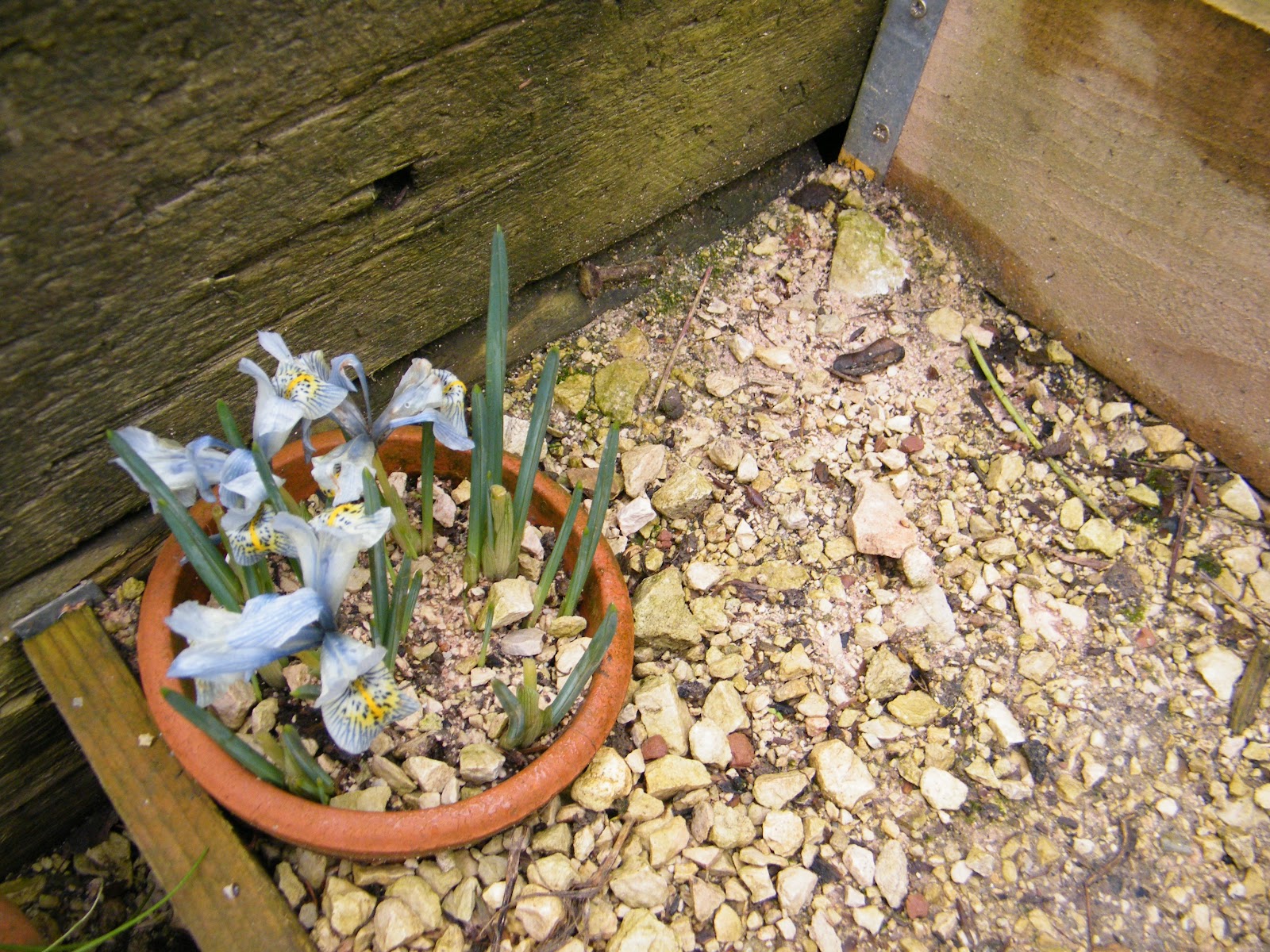
Iris Katharine Hodgkin

Val Bourne describes these beauties thus: "As subtle as a hand-painted paperweight. This early dwarf iris needs close inspection if you are to enjoy the silver-blue petals streaked, veined and spotted in sea-green and yellow."

My acquisitive little heart longed for this iris for so many years, but I didn't have the steps until now.  Katharine Hodgkin needs sharp drainage and a jolly good baking over the summer months, so from the drawing board stage of this garden I've planned to have a crock pot of these set into the eastern edge of the top steps where they'd catch most sun all year.  I'd prepped this little staging post so well, even going to the trouble of positioning an empty pot of the correct size into the "temporary garden steps" to check the angle of the sun at monthly (and weekly from March onwards) intervals to ensure the correct height vs. sunlight/shade.  Top steps would also enable me to get a really good, close look at these Iris too.  Yep, got it all worked out and perfectly positioned.

What I hadn't considered was the draining effect of the hoggin on this delicately coloured Iris.  I need a darker backdrop to properly show the beauty of these petals; hoggin just won't do.  Elsewhere in the kitchen garden I threw in some vibrant purple Iris from a B&Q multi-pack that looked stunning last month against the deeply manured and enriched soil, and which would look even better against my hoggin-topped steps.  Katharine needs an autumn move into the beds, I'm afraid, to give the backdrop these Iris really deserve.

Tuesday, November 23, 2010

Winter Arrives In Sunny Derbyshire

It's due to turn bitterly cold tomorrow with snow forecast by the end of the week.  I couldn't be happier.  For the first time in what seems like decades, I feel as if I've caught up with myself this year in the garden.  The paths are done; the steps too.  All the borders in the kitchen garden (which figures almost exclusively in this blog) and in the rest of my gardens are deeply manured, full with this season's spring bulbs.  Last week I finished pruning back this season's growth, taking off all the monstrous Buddleia growth down to stumps; cleared a few stray bits of mock orange for no other reason than I liked its scent on my gloves; tidied up all the long rose growth and fairly hacked into that horrible evergreen bush that sits like an enormous malevolent toad in my hostas bed.  I only keep it there because it was brought into the garden by birds; it grows right under a spot where the blackbirds like to perch. I loathe evergreens, but I particularly loathe this one because it is a constant reminder of a question in my RHS exams that made me go completely blank.  "Describe 5 broad leaved evergreens suitable for use as domestic hedging."

I bet Helen Yemm is laughing her head off.

Tuesday, September 14, 2010

Jobs In The Garden This Weekend: Potting Up Spring Bulbs

It started off fairly innocuously. These things usually do. "I'll just nip to B&Qs and get a bag of gravel and get the hyacinths in." I refuse to pot them up in compost anymore, as I'm sick of hoovering around the window ledges each spring. And of course, last year at my farming neighbour's New Year's party everyone admired the artful glass cubes of spring bulbs planted in green glass chippings. I wasn't the only one who wondered if she'd raided the local cemetery, either. I dropped the bag of small white gravel onto one of the garden benches, because there wasn't enough space in the outhouse.
I usually move into the outhouse at this time of year; hanging and plucking pheasants from the rafters, rummaging around the freezers for soft and top fruit for weekend crumbles, and potting up bowls of spring bulbs because I like to stack and store my compost in the dry. Also its usually raining most days and I hate to stop gardening just because it's raining.

The outhouses have accumulated no end of rammel over this summer, and I'm not really sure why. A little fellow further along the road discovered Beloved Firstborn's childhood store of plastic weapons earlier this year whilst his mum and I bent over the freezers looking for fish heads. Emerging triumphantly some minutes later, we turned around to find said little fellow sitting captivated in the middle of the floor surrounded by vintage Star Wars crap; spud guns; catapults; AK47s; assorted handguns including Smith and Wessons; multiple pump action shotguns, and at least one "Uzi 9mm." You can try as hard as you like to give your little boy wooden swords and bows and arrows from the Early Learning Centre. At some point he will return fully loaded from a shopping trip to Toys R Us with a sniggering maternal uncle.

The mess gradually bred and this afternoon I called "enough!" I changed into my gardening gear and focused my cross hairs. I started out shifting the toolbox, wind-up hosepipes, strimmers, lawnmower and hedge trimmers, extension cables, stacker boxes, slates and tiles and a couple of bags of Blue Circle, and into the space created assembled then shifted three packs of IKEA rammel-storing shelving units. Onto said shelves I sorted then stacked all the French beers, wines and spirits; all the dishwasher tabs; the car gear; the garden gear; the Christmas outdoor fairy lights; all my Bosch hand tools; Beloved Firstborn's arsenal; assorted hurley sticks and hockey sticks, ice hockey blades and sticks, dinghys, paddles, roller blades and fishing nets; multi-cell planting cells and seed trays and more plastic plant labels than you could possibly imagine.

I found glue guns, boxes of buttons and odd bits of string; no end of green garden wire and several knackered secateurs. Why don't I just throw old gardening kit straight in the bin? Who in their right mind really believes they'll ever sew up the shredded fingers of gardening gloves?

By this stage, of course, the decluttering madness was upon me. You know those bendy plastic flexi-tubs? I filled two with bits of wood and old fence posts that over the years I'd had the sense not to throw onto my bonfires in case they exploded and sent white hot nails flying all over the garden. "Don't worry neighbours! It's only tonight's son et lumiƩre; "Belfast, 1972!"
As I drove into the "municiple recyling facility" (that's the tip, to you and I), I caught the horrified stares of the workers, and I hadn't even told them they'd have to help me empty the car as I'd run out of brufen this morning and my back was too sore to move.
I'm sitting here in the most wonderful position, because it's too painful to sit any other way, and those bloody hyacinths still aren't potted up.

Wednesday, August 25, 2010